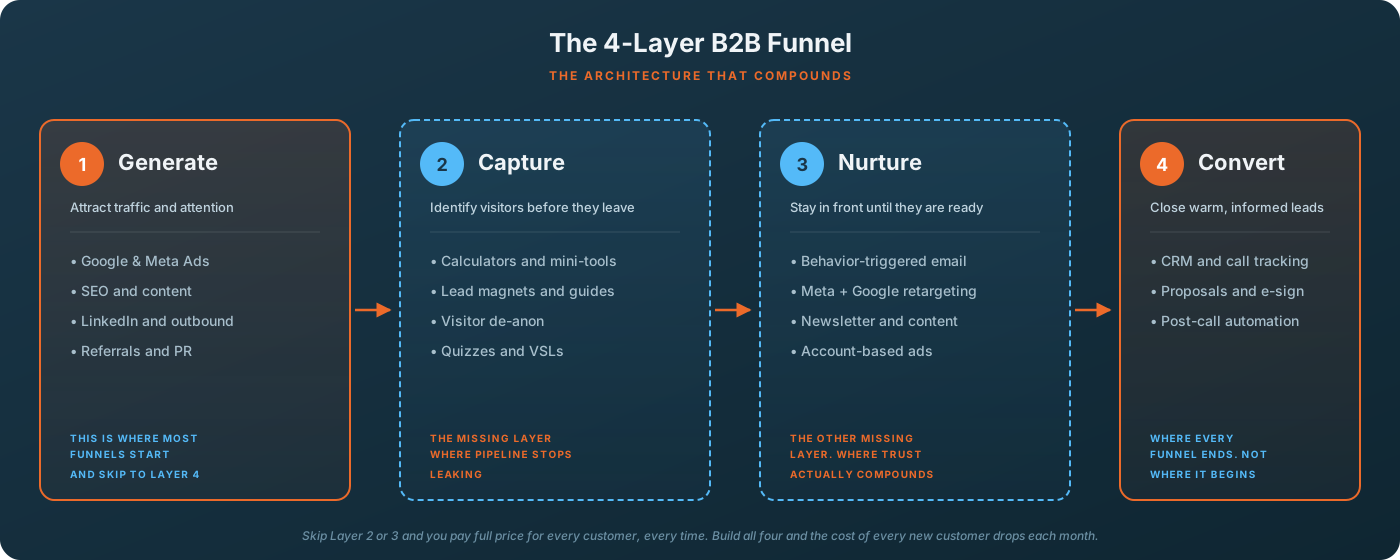
This is the 561 Media 4-Layer B2B Funnel Framework. It is the architecture we developed after auditing hundreds of B2B marketing programs and watching the same pattern break every time. Every client engagement at 561 Media runs through this framework. We are publishing it here in full so you can score your own funnel against it, and build the two layers most companies skip.
Most B2B funnels we audit have exactly two layers. Traffic comes in at the top, a small percentage of that traffic books a call, and everything in between is a black hole. No capture, no nurture, no second chance. If a prospect is not ready to fill out the contact form on the first visit, they are gone, and the business pays to acquire them all over again the next time they show up in a Google search result.
Picture a B2B SaaS brand running a clean website, a real product, a paid media budget, and an outbound team. Traffic is arriving. Demos are getting booked. And yet pipeline flatlines quarter over quarter. When we audit that funnel, the gap is always the same. The only thing the website does with a visitor is try to book a demo. Anyone who is not ready to book a demo on the first visit gets nothing, and they disappear. Eight thousand monthly visitors, a handful of hand-raisers, and nothing in between.
This business is not failing because of bad copy or the wrong channel. It is failing because the funnel is built on a coin flip. The real architecture behind a B2B funnel that compounds has four layers, and the two that almost everyone skips are the two where pipeline is actually built.
The 2-Layer Trap
Here is the shape of the funnel we see at almost every B2B company between $1M and $10M in revenue. Layer 1 is generation. Ads, SEO, cold outreach, social, referrals, webinars. Traffic shows up. Layer 4 is conversion. Sales calls, proposals, close. A closed customer appears on the other side.
Between those two layers, there is nothing. No intermediate offer for the prospect who is curious but not yet shopping. No mechanism to identify the 97 percent of website visitors who leave without filling out a form. No follow-up system for the person who read three blog posts, bookmarked the pricing page, then got pulled into a meeting and forgot the company name. The entire strategy depends on a stranger showing up at exactly the moment they are ready to buy, and remembering you on their own if they are not.
That is not a funnel. That is a wish. You can grow a business on a 2-layer funnel for a while, because raw ad spend and raw SEO effort will eventually push enough people all the way through the gap. But you will never compound, because every sales conversation starts from zero.
Layer 1: Generate
This is the layer most businesses understand, and the layer most agencies sell. We run Google Ads targeted at high-intent commercial keywords. We build SEO programs that target both informational and transactional search queries. We run Meta and LinkedIn Ads for awareness and retargeting. We do local SEO and Google Business Profile optimization where geography matters. We run cold outreach campaigns for B2B clients where the buyer list is finite and targetable. We help clients build referral loops and reactivate dead leads.
Generation is not the hard part. Generation is solved. Every client we onboard already has at least one generation channel working at some level. If they have a marketing budget at all, they are spending it here.
The problem is that Layer 1 on its own is a leaky bucket. A SaaS brand running twelve thousand dollars a month in Google Ads does not have a traffic problem. It has a capture and nurture problem. We could double that ad spend tomorrow and the cost per acquired customer would not move, because the broken part of the funnel is not at the top. It is in the middle, where nothing was ever built.
Layer 2: Capture
Capture is the layer where you convert anonymous traffic into identified prospects you can market to later. Not prospects who are ready to talk to sales. Prospects who are ready to give you their email address, their name, or their company in exchange for something that is useful to them right now.
Think about that same SaaS brand with six thousand monthly website visitors. If the only conversion option on the site is a Book a Demo button, the conversion rate will sit somewhere around 2 percent, maybe 3 percent on a good month. That is 120 to 180 leads. The other five thousand eight hundred and twenty visitors paid for by the ad budget or earned by SEO are gone. They will not remember the brand in thirty days. They did not save the URL.
Now add a Layer 2. A savings calculator tied to the product's value prop. An interactive maturity assessment that scores the prospect's current setup against a benchmark. A migration cost estimator that lets the prospect plug in their current vendor and see what switching would actually cost. A weekly newsletter about the specific operational problem the product solves. Suddenly the visitors who were never going to book a demo today but were willing to trade an email for a useful answer become identifiable leads. Those leads are now in the CRM. You can email them, retarget them, and stay in front of them until the day the pain point becomes urgent enough to take a meeting.
What Layer 2 looks like in practice
We build capture mechanisms in five flavors, depending on the client:
- Mini-tools and calculators. We built our own ROI calculator at 561media.com/roi-calculator as an example of this done right. It exchanges a few minutes of interaction and an email for a personalized number. A SaaS brand can run a savings estimator, a benchmark report tool, or a setup audit that generates a custom score.
- Lead magnets and buyer guides. Industry reports, buyer checklists, category comparison guides, and spec sheets. The best lead magnets answer the single question a prospect is Googling at eleven at night the day before a big decision.
- Visitor de-anonymization. Tools like RB2B and similar services can identify a meaningful slice of anonymous B2B website traffic, match it to LinkedIn, and push that identity into your CRM. For B2B SaaS, this turns a pricing page visit into a named account you can route to an AE.
- Interactive quizzes and Typeform or Tally flows. \"Which plan fits your situation?\" A quiz converts far better than a static form because it feels like a conversation, not a commitment.
- Video sales letters and gated case studies. A six to twelve minute video that walks a prospect through the offer, the process, and the proof. The prospect self-qualifies before any human time is spent.
The point is not to pick all five. The point is to pick at least one. Right now, most B2B websites have zero.
Layer 3: Nurture
Capture without nurture is a dead list. We have walked into HubSpot instances with four thousand contacts that have not received an email in eighteen months. The business owner will tell us \"those leads are cold.\" They are not cold because of the passage of time. They are cold because nobody ever kept them warm.
Nurture is the set of systems that stay in front of a captured lead from the day they first raise their hand until the day they are ready to buy. For some products that window is two weeks. For enterprise B2B SaaS, it can be nine to eighteen months. The buying cycle is whatever it is. The question is whether you are present for it.
The four nurture systems we build
We typically stand up four overlapping systems, not as separate channels but as one connected pipeline:
- Email automation keyed to behavior. HubSpot, Customer.io, or Klaviyo running sequences triggered by what the prospect actually did. The person who downloaded the buyer guide gets a different sequence than the person who visited the pricing page three times. The person who watched sixty percent of the VSL gets a different sequence than the person who bounced after ten seconds. Generic monthly newsletters are the bare minimum. Trigger-based automation is where the compounding happens.
- Retargeting across Meta, Google, and LinkedIn. A prospect who visits your website should see your brand again on Instagram tonight, on a news site tomorrow, and in their LinkedIn feed on Friday. For B2B, account-based retargeting lets you stay in front of entire buying committees at a target company, not just the one person who hit the site.
- A real newsletter people actually want to read. Not a product announcement blast. A newsletter that delivers a specific, useful insight every week or every month, tied to the prospect's actual problem. The newsletter is where trust compounds week over week without you paying for every touch.
- Content marketing as nurture, not as generation. This is the part most businesses get wrong. Blog posts, LinkedIn posts, and long-form content are poor lead generation tools in 2026. What they are excellent at is building recognition and credibility with the leads you already captured. Every time a prospect sees your content in their feed, the eventual sales call gets easier. The blog you are reading right now is Layer 3 for 561 Media. It is how we keep warm the leads we already have.
Nurture is where a 2 percent form conversion rate becomes a 6 percent form conversion rate six months later, because the same traffic is now running into a prospect who has already seen your name eight times. The cost per lead did not change. The quality of the lead changed.
Layer 4: Convert
Layer 4 is the layer everyone already knows how to run. A CRM, a calendar, a proposal tool, call tracking with CallRail, a sales rep who is good on a demo, a post-call automation that sends the proposal while the conversation is still warm. There is nothing exotic here.
What changes in Layer 4 when the first three layers are built correctly is the shape of the sales conversation. Instead of pitching, you are confirming fit. The prospect already knows what you do, already knows roughly what it costs, already trusts the process because they have been reading your emails for three months. The call is about whether this specific project is a good match, not whether your company is credible.
Our best-converting clients have sales calls that last twenty-two minutes and close at forty percent. Our worst-converting clients have sales calls that last fifty-five minutes and close at eight percent. The difference is almost never the salesperson. The difference is what happened in Layers 2 and 3 before the call was booked.
Why Four Layers Compound
Each layer makes every other layer work harder. Your Google Ads get cheaper because the retargeting pixel keeps prospects in your orbit after they click. Your SEO traffic turns into actual pipeline because the lead magnet captures people the contact form would have missed. Your newsletter closes deals because the prospect has been reading it for four months and already trusts how you think. Your sales calls convert higher because every person on the call arrived warm.
On a 2-layer funnel, you pay full price for every customer every time. On a 4-layer funnel, the cost of acquisition drops each month you run it, because the middle layers keep working on leads you already paid to acquire. The flywheel is not a metaphor. It is just what happens when capture and nurture are built to do their jobs.
And here is the part we want every B2B operator to hear clearly: this framework does not care what you sell. We use the same 4-layer architecture across SaaS, professional services, eCommerce, home services, and B2B industrial. The media mix changes. The capture offer changes. The tone of the newsletter changes. The architecture does not.
How to Build the Missing Layers
If you are reading this and you already know your funnel has only two layers, start here. Pick one capture mechanism and build it this month. A calculator, a guide, a quiz, a VSL, a de-anonymization tool. Just one. Put it in the highest-traffic spot on your website and measure what it does to your capture rate over thirty days.
Then pick one nurture sequence and wire it to that capture mechanism. Not a twelve-part masterpiece. A five-email sequence that delivers value and stays out of the way. Set up a weekly or biweekly newsletter on the same list. Turn on retargeting across Meta and Google at a minimum, LinkedIn if you are B2B.
If that sounds like a lot, it is not. It is the difference between a business that grows by spending more and a business that grows by compounding what it already spent.
Not sure where your funnel actually stands? Take our free 3-minute Funnel Diagnostic. Answer 10 questions and we will score your funnel against the 4-layer architecture, show you which layers are weak, and email you a personalized fix-it plan for the ones you need to build first.
Ready to see which layers your funnel is missing?
We will audit your funnel end to end, show you the gap in 30 minutes, and hand you a build plan for Layers 2 and 3. No sales pitch. You will leave with a specific next step whether or not you ever hire us.
The revenue ceiling on a 2-layer funnel is real, and it is closer than you think. The good news is that the ceiling is not about your product, your market, or your team. It is about the two layers nobody ever told you to build.